
Tenerife is famous for its exceptionally clear skies, which is one of the reasons the island has become such an important destination for astronomy and stargazing. However, visitors occasionally hear the word “calima” and wonder what it means and whether it will affect their stargazing experience.
The important thing to understand is that significant calima events are relatively infrequent, particularly when considering the number of excellent stargazing nights Tenerife enjoys throughout the year. Calima also isn’t simply an on-or-off weather condition — there are very different degrees of calima.
What is a calima?
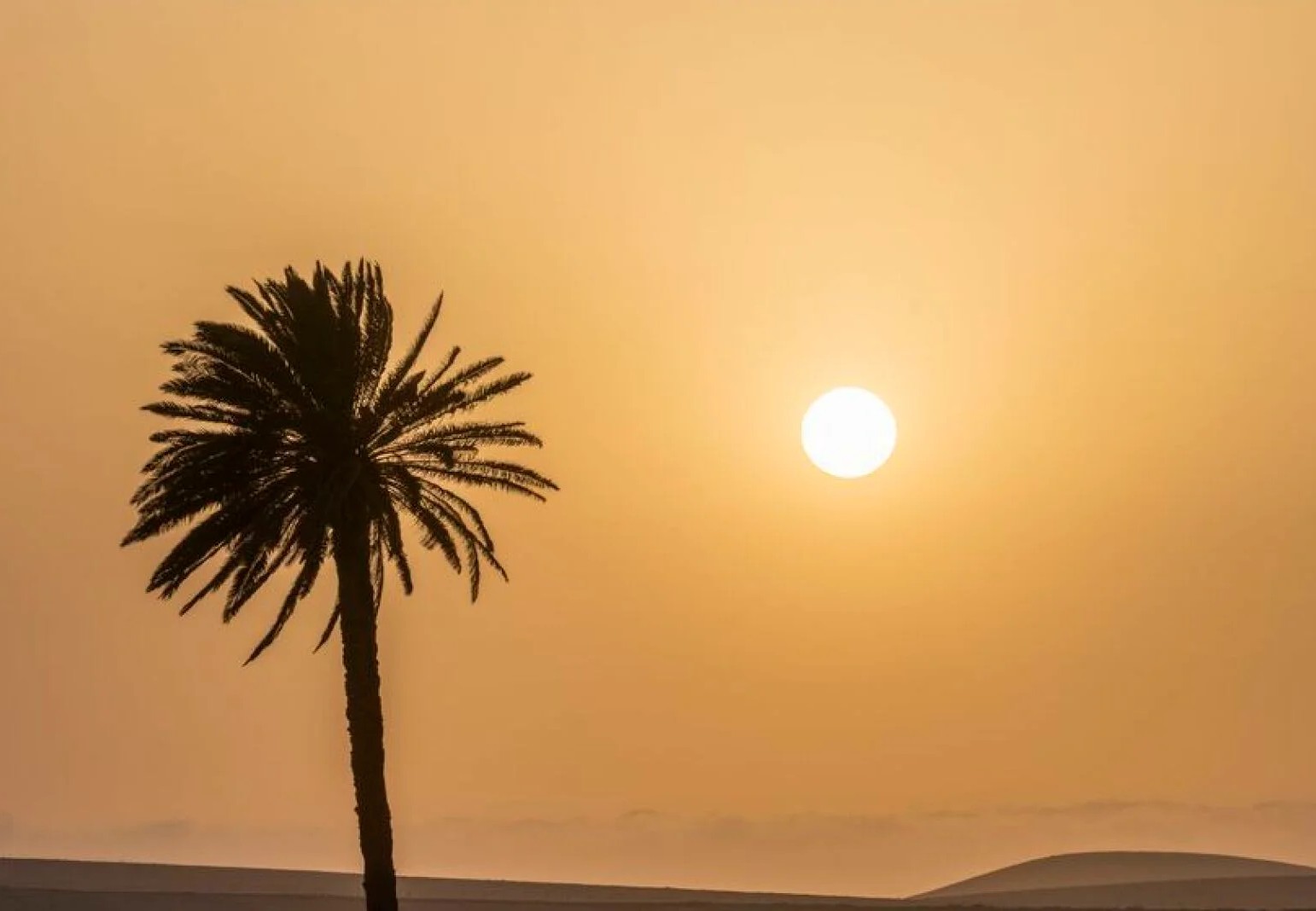
A calima occurs when very fine particles of dust from the Sahara Desert are carried across the Atlantic towards the Canary Islands.
Depending upon the atmospheric conditions, the amount of dust reaching Tenerife can vary enormously. Sometimes the concentration is so slight that most visitors wouldn’t even notice it. On other occasions, a stronger calima can create an obvious haze and significantly reduce visibility.
This distinction is particularly important for astronomy.
Not every calima means poor stargazing
The word “calima” can sometimes sound rather dramatic in weather forecasts, but a forecast of Saharan dust doesn’t automatically mean that stargazing will be poor.
There are light, moderate and occasionally strong calima conditions.
During a light calima, the sky can still be perfectly suitable for an enjoyable evening of astronomy. Bright stars, planets and many other objects can remain clearly visible through our telescopes.
A moderate calima can reduce transparency. The stars are still there, but some of the fainter objects become more difficult to see because the dust scatters light passing through the atmosphere.
It is mainly during a strong calima that astronomical observing can become seriously affected.
Fortunately, conditions severe enough to prevent us from providing a worthwhile stargazing experience are relatively uncommon.
Why altitude makes a difference
Our stargazing takes place high on Mount Teide, at approximately 2,200 metres above sea level.
This is completely different from observing from Tenerife’s coastal resorts.
On many nights we drive through the lower cloud layer and emerge into beautifully clear skies above it. The high altitude, dry atmosphere and low levels of light pollution are among the reasons Tenerife is internationally recognised for astronomy.
Calima is different from normal cloud, however. Saharan dust can occur at different atmospheric levels, so being high on Teide doesn’t necessarily mean we are completely above it.
This is why our guides assess the actual astronomical conditions rather than simply seeing the word “calima” on a weather forecast and assuming that observing will be impossible.
Calima and the Moon — not a good combination
There is one combination that we particularly dislike for stargazing:
A significant calima combined with a bright Moon.
The reason is light scattering.
Under a beautifully transparent Tenerife sky, moonlight is relatively well controlled. But when there is a substantial amount of Saharan dust suspended in the atmosphere, those tiny particles scatter the Moon’s light across the sky.
Instead of having a dark background, the sky can become noticeably brighter and hazier.
This reduces contrast and makes faint deep-sky objects considerably more difficult to observe.
So a moderate calima on a dark, moonless night can sometimes produce much better astronomical conditions than the same amount of dust when there is a bright Moon in the sky.
For us, therefore, it isn’t simply a question of:
“Is there a calima?”
We consider how strong the calima is, the altitude and distribution of the dust, the Moon phase, atmospheric transparency and the objects we intend to observe.
What about astrophotography?
Calima can also affect astrophotography.
A small amount of Saharan dust doesn’t necessarily prevent us from taking images, particularly of brighter objects. But as the concentration increases, the dust reduces contrast and scatters artificial light and moonlight.
Long-exposure photographs can therefore show a brighter background than they would under Tenerife’s normally transparent skies.
Again, the Moon makes a substantial difference. Strong moonlight combined with significant calima is one of the least favourable combinations for deep-sky astrophotography.
Should visitors worry about calima when booking?
Generally, no.
Calima is part of the climate of the Canary Islands, but significant events are occasional rather than the normal state of Tenerife’s night sky. There are also many occasions when a small amount of Saharan dust is present but has little meaningful effect on an evening’s observing.
Our approach at Stargazing Tenerife is to look at the conditions that actually matter for astronomy.
Weather apps are useful, but astronomy on Mount Teide is more complicated than looking at a cloud symbol or seeing “calima” mentioned in a forecast.
We consider the strength of the dust event, cloud levels, humidity, wind, astronomical transparency and the Moon before deciding what conditions are likely to be like at our observing location.
Tenerife remains an exceptional place for stargazing
Calima occasionally reminds us that even one of the world’s great astronomical locations has weather!
But it shouldn’t give visitors the impression that Tenerife regularly suffers from poor astronomical visibility. Most of the time, calima is either absent or not strong enough to seriously affect our stargazing.
And when conditions are good, standing high on Mount Teide beneath Tenerife’s dark sky remains an extraordinary experience.
The key is understanding that not all calimas are equal.
A little Saharan dust can be perfectly manageable.
A stronger calima can reduce transparency.
And a strong calima combined with a bright Moon is the situation astronomers would rather avoid.
At Stargazing Tenerife, we monitor the conditions carefully so that our guests have the best possible opportunity to experience the remarkable night sky above the Canary Islands.
I can also make this more SEO-focused for the Stargazing Tenerife website, targeting searches such as “Does calima affect stargazing in Tenerife?”, “Tenerife stargazing weather” and “best conditions for stargazing on Mount Teide.”