

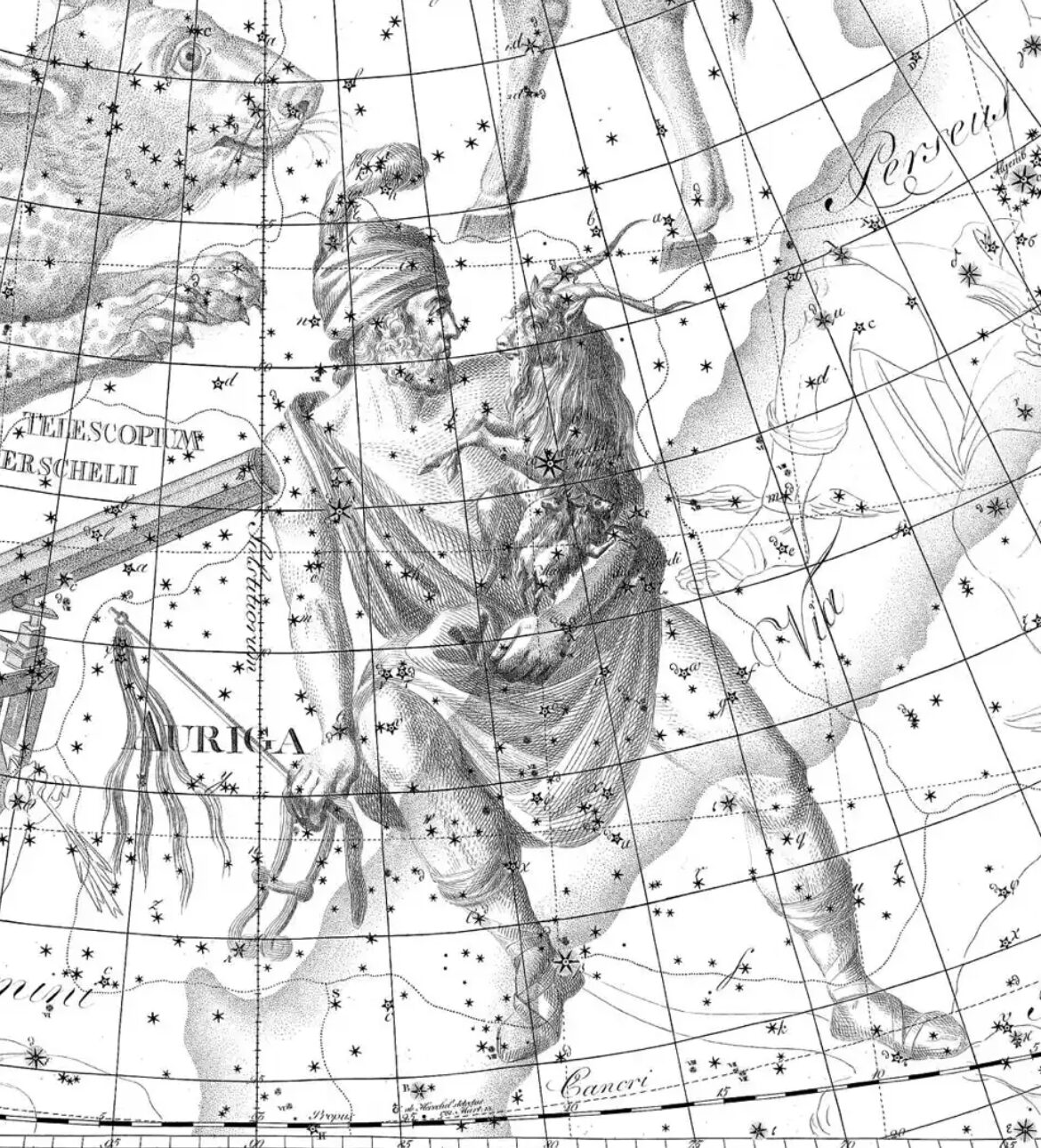
The winter sky is beaming with beautiful bright stars and nebulae in the Teide National park this time of year and one of the long lasting evening constellations to be seen is none other than Auriga, the Charioteer. The constellation is classically depicted by a King holding the reins of his chariot in one hand while cradling a she-goat and her two kid goats in the other hand. Yes, Greek mythology is wild!
Shimmering and refracting above the Canarian peninsular horizon is the beautiful and bright star Capella which has a magnitude of 0.8 making it disco ball refract in the early winter evenings as the brightest star in the constellation of Auriga. What looks like a singular point of light to the naked eye is actually a quadruple star system collectively shining to be considered the 3rd brightest star in the northern hemisphere.
Resembling an irregular hexagon in shape and hanging between Perseus and Gemini in the sky, Auriga is home to the so-called Galactic anticentre of the milky way being closest to the star Elnath in the constellation.
There are many interpretations and incarnations of the myth of Auriga but of course we are going to stick with the most popular one in Greek mythology which is of Erichthonius, a legendary King and early ruler of Athens raised by Athena the Virgin goddess of wisdom, warfare and handicraft, to be a skilled horseman and Chariot rider of such legendary proportions that Zeus himself raised Erichthonius to heavenly status for eternity in the stars.
The crazy birth from a wooly discarded excretion rag is another Greek mythology story that baffles the mind but here goes. According to myth, Poseidon didn’t like Athena, probably for some petty reason and so tricked Hephaestus into thinking the virgin goddess wanted to have sex with him. Erichthonius was born of the spilled seed of Hephaestus after he attempted to seduce Athena, who rejected him. That’s the PG version. The brutal version is, after Posidon’s trickery, the impure and savage Hephaestus couldn’t stop himself from trying to rape the poor virgin Athena because he was in lust with her and couldn’t control himself, like lots of the outrageous Olympians. Athena fought him off thwarting his advances, however in one of the exchanges the dirty scoundrel Hephaestus, got a bit of his jungle juice on her. Disgusted and mortified by his semen, Athena grabbed a wooly rag and wiped off the excretion thoroughly before tossing it to the floor.
From this wooly rag tossed to the floor, the floor being Gaia (Earth), Hephaestus’s extremely fertile semen spawned Erichthonius. So, unwillingly Gaia gave birth to the son of Hephaestus but she did not take responsibility or ownership for the child which was born a man serpent. Seeing as Gaia rejected the child, Athena decided she would take responsibility for the mini deformed man serpent and called him Ericthonius, which loosely translates to eternal ruler.
Athena raised Ericthonius to be a master rider who ended up inventing the four horse chariot, which he rode with great skill and poise especially considering he had no legs. The story of the rest of Ericthonius’s adult life isn’t clear but in some stories he became a great early ruler of Athens. The goats that are depicted in the constellation’s ancient drawings suggest that the rest of the myth was formed from other stories involving goats which are too numerous to count in this post.
After Ericthonius became known for the 4 horse chariot, the Quadiga, Zeus was impressed by his ingenuity and leadership of Athens among many other things and decided to place the Charioteer in the sky for eternity as praise for his awesomeness.
Come and be bedazzled by the winter hexagon asterism, Jupiter, Saturn and many more celestial objects right now on one of our Stargazing tours up at the Teide national park. Our experienced guides will bring to life the wonder of the cosmos and present to you one of the best sky’s in the world.Thanks for reading and have a great day!
Written by Phil


