
One of the fascinating things about the night sky is that it changes depending on our position on the planet and also, more importantly, depending on the time of the year. Come December, in fact, the summer sky with the Milky Way core gives way to the winter constellations during our sunset and stargazing tours, which will keep us marveling at them until the end of spring. There are plenty of interesting celestial objects located in that portion of the sky and future posts will highlight them, but we want to focus this entry on arguably the crown jewel of the winter sky, the constellation of Orion, also known as the Hunter. Listed by Ptolemy in the 2nd century AD as one of the 48 constellations, it had already caught the attention of other civilizations such as the Babylonians, the Egyptians, the Chinese, the Indians, the native Americans and the Austronesians because of its unmistakeable pattern, and it was considered alternatively a shepherd, a god, a cosmic dancer.
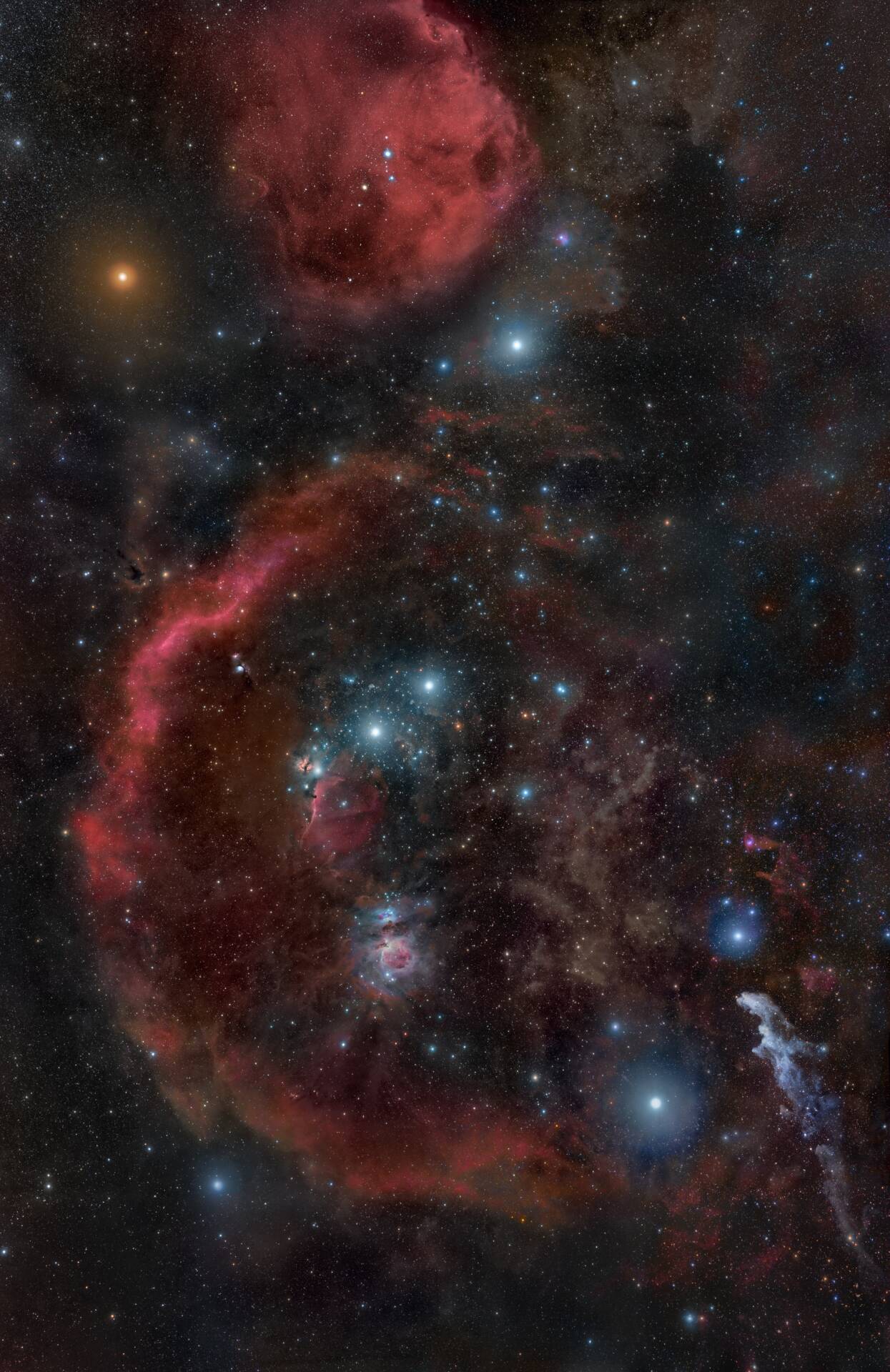
When you look up at the night sky this time of the year, the first pattern you will notice is three stars of the same apparent brightness in a row, Alnitak, Alnilam and Mintaka (blue supergiants), which represent Orion’s belt. Dangling just below the belt, it looks like there is a line of stars, but one of those ‘stars’ is actually the Great Orion nebula, the closest star-forming region in the sky to Earth (approximately 1.300 ly) and the only one visible to the naked eye. Around the belt, starting from directly above, there is a small group of 3 stars making up the head of the hunter, with the brightest called Meissa. To either side, left shoulder is Bellatrix whereas the other is the orange-looking, red supergiant Betelgeuse. This star is of particular interest to astronomers and astrophiles because it is expected to go supernova within the next 100.000 years and, when it happens, it will be visible from our planet as a massive glow brighter than the Moon. Underneath the belt, two stars make up the feet of Orion: the very bright blue supergiant Rigel on one side and Saiph on the other, making up the body of the hunter. The constellation, however, extends beyond the body as it appears to hold a club in his right arm and a shield on his left one. Once you see it, you cannot unsee it!
One thing to notice, and that holds true for every constellation, is that although the stars seem to be on a two-dimensional plane, they are actually at very different distances from Earth, in some cases up to 1.000 light years apart, so what resembles a human figure on our planet doesn’t represent anything from a different vantage point. As a matter of fact, Bellatrix is ‘only’ 250 light years away, whereas Mintaka is approximately 2.000 light years away!
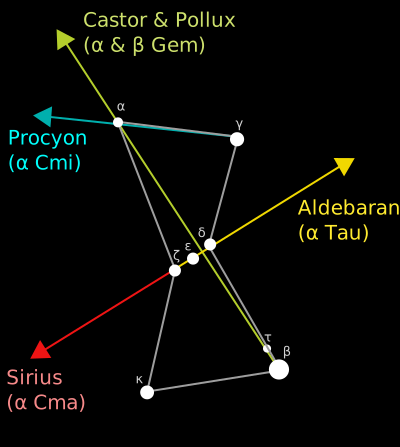
Another interesting fact is that, because of its unique and readily recognizable shape, it has been used by stargazers throughout history as a signpost pointing to different stars and constellations (see figure), just like the Big Dipper (or the Plough).
As any respectable hunter, Orion is accompanied by two dogs, the constellations Canis Mayor and Canis Minor that can be respectively found by drawing a line through the belt to the east (pointing to the bright star Sirius) or through the shoulders to the east (pointing to Procyon).
As you may know already, Orion is so unique and beautiful that we chose it as the logo of our company, Stargazing Tenerife!